

Understanding Your Invoice & Trust Account
Please Review Every Invoice—Even If Your Balance Due Is $0.00
Your invoice provides information about legal fees and expenses charged to your matter, payments applied to those charges, funds remaining in your trust account, and whether additional funds are currently due. These amounts mean different things.
The Five Amounts You Should Review
The amounts on your invoice are related, but they’re not interchangeable. Below, you’ll find a listing of invoice fields and what they mean.
The Invoice Amount shows the legal fees and expenses charged on the current invoice.
Review the descriptions of work performed, the time billed, and the amount charged.
The Amount Applied shows funds applied toward the charges reflected on the invoice.
When funds held in your trust account are used to pay earned legal fees or expenses, those funds reduce the amount remaining in your trust account.
The Current Trust Retainer Balance is the amount currently remaining in your trust account after the transactions reflected on your statement. Your trust balance may decrease as legal fees are earned and expenses are incurred.
A replenishment is different from the legal fees charged on the current invoice.
The Balance Due shows the amount currently due according to the invoice.
Depending on the status of your account, the Balance Due may be $0.00 or may reflect an amount required to replenish your trust account.
Two Common Billing Situations
Situation 1: Work Was Performed, But My Balance Due is $0.00
EXAMPLE ONLY
Invoice Amount: $500.00
Other Outstanding Balances: $0.00
All Invoices Amount: $500.00
Current Trust Retainer Balance: $4,500.00
Amount Applied: $500.00
______________________________
Balance Due: $0.00
What happened?
- The Firm performed $500.00 of legal work.
- Funds held in your trust account were used to pay those fees.
- Your trust balance decreased by $500.00.
Because the current charges were paid from funds held in trust and no additional payment is currently shown as due, your invoice displays a Balance Due of $0.00.
Situation 2: My Invoice Shows a Trust Retainer Replenishment Due
EXAMPLE ONLY
Invoice Amount: $500.00
Other Outstanding Balances: $0.00
All Invoices Amount: $500.00
Minimum Trust Retainer Balance: $5,000.00
Current Trust Retainer Balance: $1,500.00
Trust Retainer Replenishment Due: $3,500.00
All Invoices plus Trust Retainer Replenishment Due: $4000.00
Amount Applied: $500.00
______________________________
Balance Due: $3,500.00
What happened?
- The Firm performed $500.00 of legal work.
- Funds held in your trust account were applied toward those fees.
- After the transactions reflected on the statement, $1,500.00 remained in trust.
- The invoice shows a Minimum Trust Retainer Balance of $5,000.00.
- The amount needed to restore the trust balance to $5,000.00 is $3,500.00.
- The invoice therefore shows a Trust Retainer Replenishment Due and Balance Due of $3,500.00.
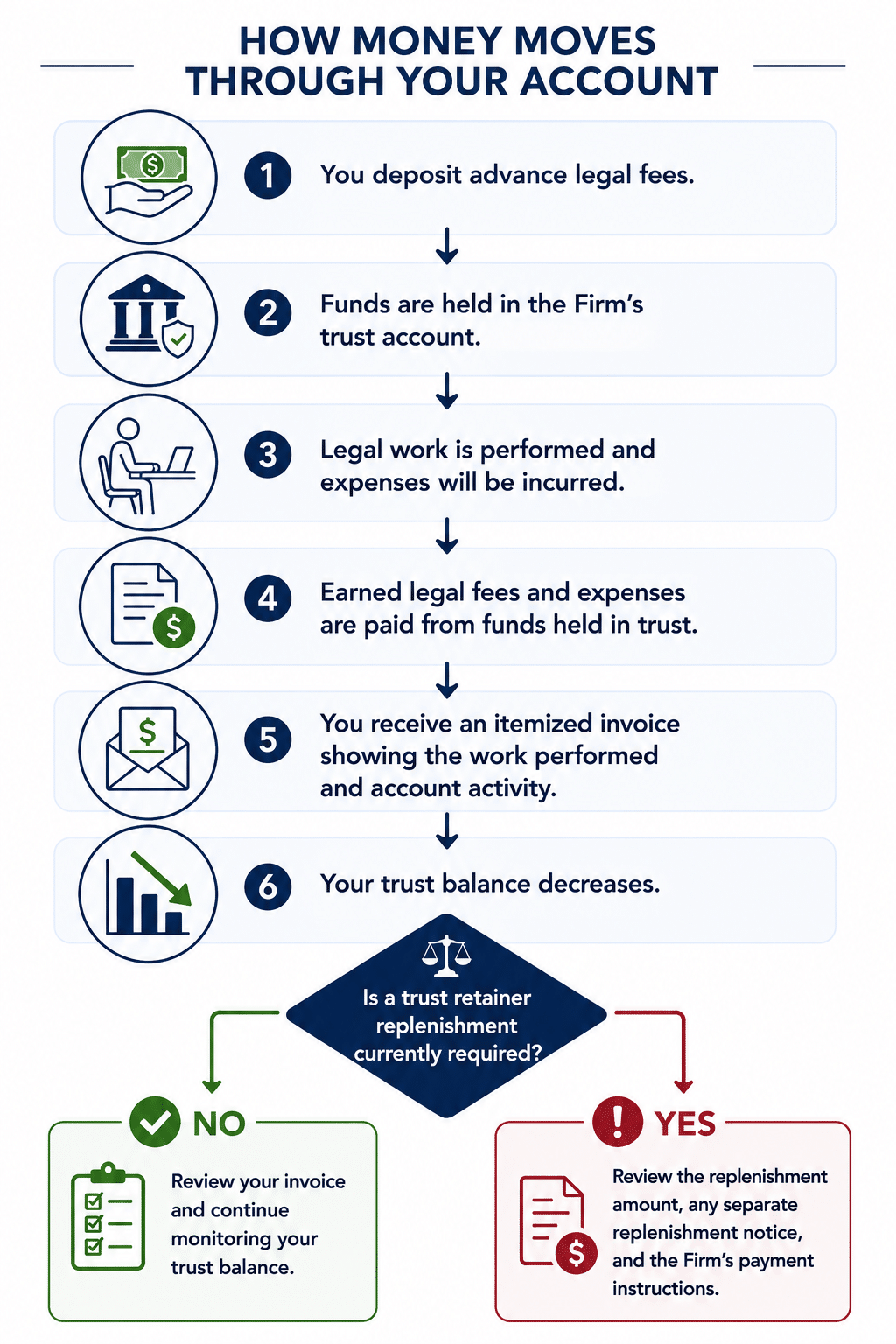
How Money Moves Through Your Account
When you retain The Firm For Men, you deposit an Advance Legal Fee, which is held in the Firm’s trust account. As we work on your case, we bill against this amount.
Every two weeks, you receive an itemized invoice showing the work performed and all account activity. Here, you’ll see funds transfers and your trust balance.
If no trust replenishment is required, you will see $0.00 balance due. Please continue monitoring your account so you can ensure it’s kept current.
If your invoice shows a balance due, please review the replenishment amount, any separate replenishment notice, and the Firm’s payment instructions.
If you have questions about your invoice, please call our office so we may assist or email billing@thefirmformen.com.
Frequently Asked Questions
Still Have Questions About Your Invoice?
If you have questions about a specific charge, the amount shown as due, or your trust account activity, please contact:
Billing Department
billing@thefirmformen.com
When contacting the billing department, please include:
- Your name and invoice number.
- The specific charge, amount, or invoice field you are asking about.
- A brief explanation of your question or concern.
- The best way to contact you regarding your question.
Please do not send sensitive financial information, Social Security numbers, or credit card information by email. The Firm’s Communication Policy directs clients to use the secure client portal for sensitive information.